
Doctor Who was timey-wimey long before the Weeping Angels and confession dials. If the 1981 story ‘Warriors’ Gate’ ever fried your brain, we’ve got you covered: it’s time to find out what, exactly, this bizarre tale is all about…
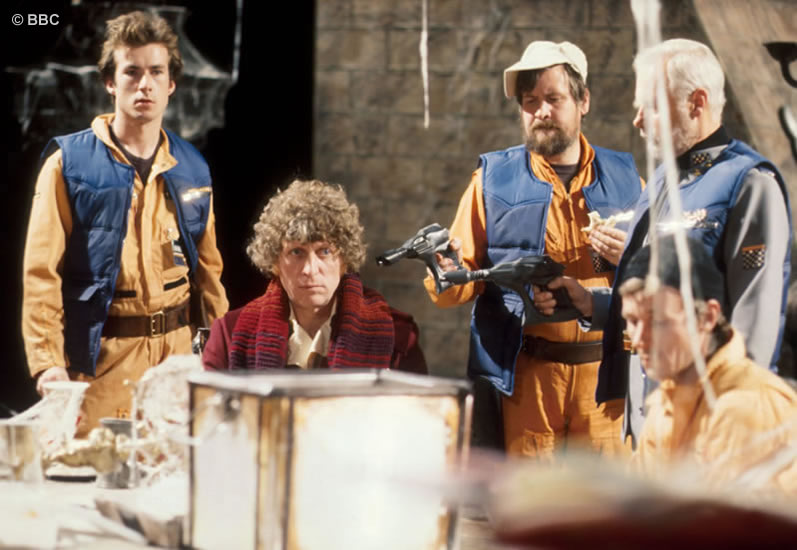
Season 18 was a time of dramatic change for Doctor Who. Incoming producer John Nathan-Turner, together with his script editor Christopher H. Bidmead, wanted to take the programme more seriously, and bring it to a more sophisticated audience. As Nathan-Turner put it in an interview on the BBC DVD range, he wanted to dispense with the “undergraduate humour” and “get the science right.”
Certainly, if you ever watch ‘Warriors’ Gate,’ you will notice a distinct lack of “undergraduate humour,” although there are moments of levity. As for the science – well, you might have to take Christopher Bidmead’s word on that one.
‘Warriors’ Gate’ was, of course, penned by Stephen Gallagher, although he credits much of the final result to Bidmead as the show’s script editor. Bidmead, incidentally, was an amateur scientist himself, and was keen to weave his knowledge into the fabric of the programme to ground it in a scientific reality, often to the bewilderment of the casual viewer, and indeed the cast.
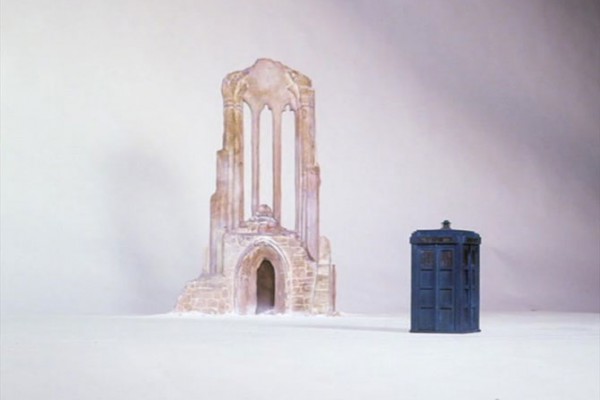
In ‘Warriors’ Gate,’ the Doctor, Romana, Adric and K9 are trapped in another universe, known as E-Space. But they’ve found the way out – the boundary between universes, which they can cross through. This boundary (a featureless void) forms the backdrop of ‘Warriors’ Gate,’ quite literally, although the TARDIS team is up against the clock, as the space is collapsing in on itself owing to the presence of another spaceship.
This spaceship belongs to Captain Rorvik and his band of slave traders. They too are stuck in the null space, and they are keen to escape – by whatever means. And they aren’t the most amiable bunch. Rorvik has a cargo of captive Tharils – a lion-like race of time-sensitives who can be wired into the navigation systems of space vessels to help them navigate the cosmos.
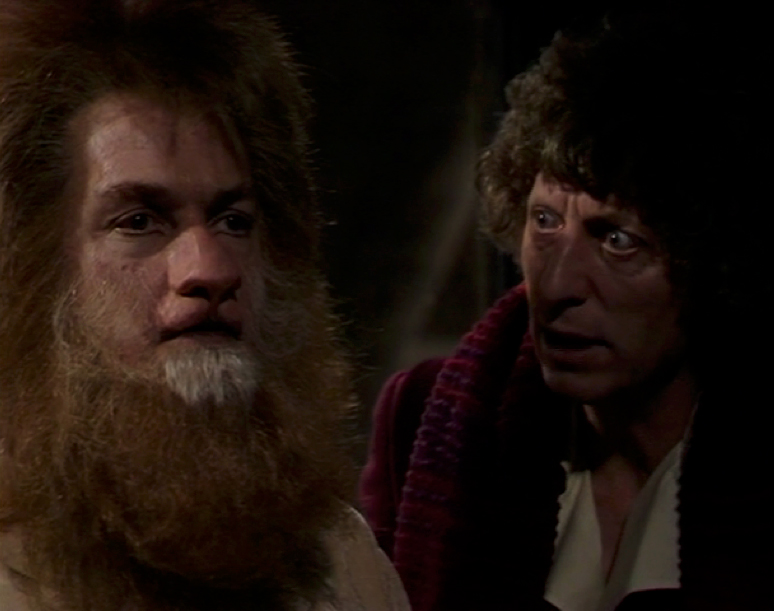
At the start of ‘Warriors’ Gate,’ one of these Tharils (Biroc) escapes and encounters the Doctor and his friends. As the story progresses, the Doctor learns that Biroc himself was once a slave master, until the warrior Gundans revolted. Biroc shows the Doctor what the Tharils’ life used to be like in a sort of ‘pocket universe’ which can be accessed by stepping through a mirror.
And once Captain Rorvik learns of this mirror, he becomes convinced that this is actually the way out of E-space, and he goes to great lengths to try and destroy it. Ultimately, he figures that only a back-blast from his own ship will be powerful enough to shatter it, ignoring the fact that it will wipe out the void space as well.
In the closing moments of ‘Warriors’ Gate,’ Romana decides to leave with Biroc through the mirror before they’re all obliterated by Rorvik. She wants to liberate the rest of the Tharil race, and the Doctor gives her K9 to take on her quest. The Doctor and Adric escape back to N-Space, whilst Rorvik blows himself up, and Romana, Biroc and K9 leave through the mirror.






Overall, ‘Warriors’ Gate’ is not the most complicated story in Doctor Who history, but it is told in a rather unique and innovative manner. For example, when the travellers first encounter Biroc, they don’t simply bump into him in the void; he steps into the TARDIS, his body ablur as he’s out of synch with their own timeline, and utters the cryptic words: “[I am] the shadow of your past and of your future.”
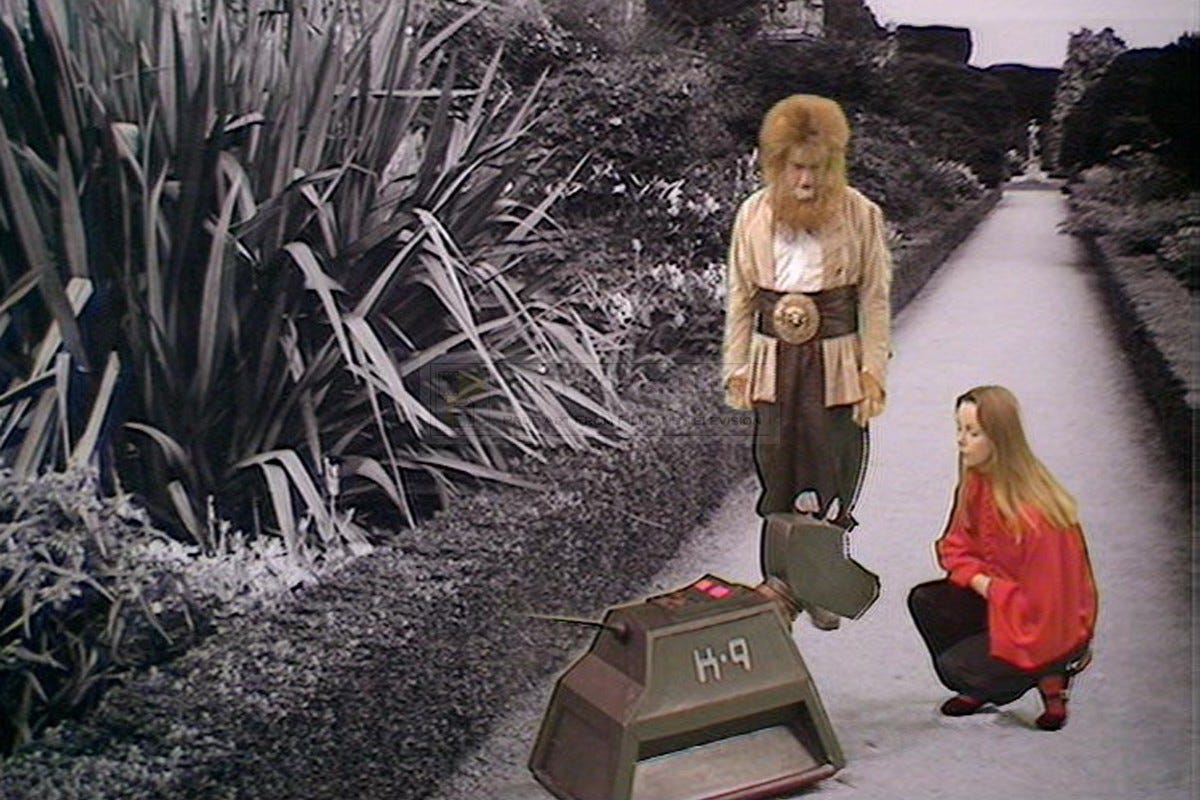
And then there is the way that the Biroc explains the history of the Tharil race. This is no traditional exposition dump; the Doctor steps through a magic mirror, and goes on a journey through a maze of monochromatic photos before stepping into a time-locked banquet which is ambushed by the robot Gundans – only to be teleported back to the ‘present,’ straight into the hands of Rorvik and his men. “Well Doctor, this is a surprise,” says Rorvik. (And for the viewer, too.)
These creative choices, whilst novel, do make the viewer scratch their heads at times, and this was probably the intention of Gallagher and Bidmead with ‘Warriors’ Gate.’ They wanted to challenge their audience and stretch their imaginations with something rather unique. Even if you come away from ‘Warriors’ Gate’ without the slightest notion of what you’ve just watched, there is no denying that it’s thought-provoking.
After all, there can’t have been many family shows airing at tea-time on a Saturday which used the I Ching for exposition (K9 gives Adric the lowdown in episode one.) For those of you who are unfamiliar, this is an ancient Chinese text which posits that nothing in the universe is random but consists of ordered, predictable events – therefore, even seemingly random acts like tossing a coin bring order out of chaos.
And in ‘Warriors’ Gate,’ the director Paul Joyce used the tossing of a coin to represent the timelessness of the null space. There is a scene in episode one where one of Rorvik’s crew tosses a coin and it freezes mid-air, demonstrating that the vessel has no arrived in a place where time has ceased to be.
Moments like this make ‘Warriors’ Gate’ feel more like an arthouse feature than a Doctor Who serial, and indeed Joyce’s direction makes this one of the most filmic Doctor Who adventures of the classic run. If you ever wanted to know what a 1980 Doctor Who movie, shot in a BBC studio, on videotape, would have looked like, this is pretty much it. ‘Warriors’ Gate’ is loaded with quirky and innovative direction – close-ups, handheld shots, endless dissolves… Joyce invested considerable time in the story’s cinematography, undoubtedly befuddling his viewers, but all-the-while building tension and atmosphere.
And it almost cost him his job. Paul Joyce was fired during the production of ‘Warriors’ Gate,’ and later re-hired to finish the job. He went against the traditions of the archaic BBC studio system, and received considerable push-back from his crew.
The result, though, is one of strangest, most thoughtful stories of the classic era – and undoubtedly one of the most innovative and cinematic. So if you’re still left scratching your head at the end of ‘Warriors’ Gate,’ don’t worry – it’s meant to be weird.
How do you feel about ‘Warriors’ Gate’? Did it make sense to you first time round, or are you still trying to figure it out? Let us know in the comments below.

Leave a Reply