
In 1987, ‘Dragonfire’ was voted the most popular story of the season in Doctor Who Magazine‘s annual poll. What is it about this adventure that won the hearts of avid fans?
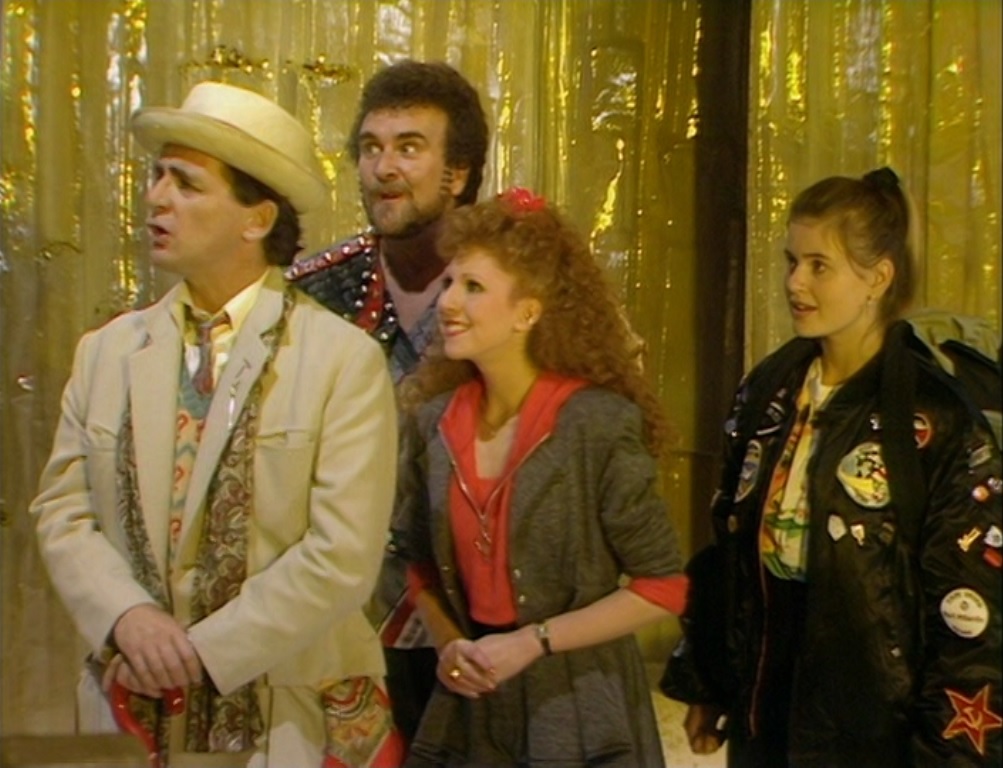
It’s fair to say that Season 24 isn’t regarded as one of Doctor Who‘s finest series. The programme was in the midst of a radical and painful change; Colin Baker had been suddenly and unexpectedly fired, and had declined to return for a regeneration. Moreover, the script editor Eric Saward had also departed, following a creative disagreement with the show’s producer John Nathan-Turner.
And so, in hindsight, it’s a miracle that Doctor Who Season 24 was made at all, including ‘Dragonfire.’ And whilst it’s fair to say that this story wasn’t exactly facing stiff competition, this doesn’t mean that it wasn’t a great adventure.
For a start, ‘Dragonfire’ introduced the character of Ace, who remains a popular companion in the modern era, having made an explosive return in Jodie Whittaker’s final story. Ace is a very different kind of companion – a ‘streetwise kid’ with a baseball bat and a love for the wanton destruction of public property. ‘Dragonfire’ serves as the perfect introduction to her character; when the Doctor meets her, she’s working as a waitress in a café, and gets fired after pouring a milkshake over a customer’s head!
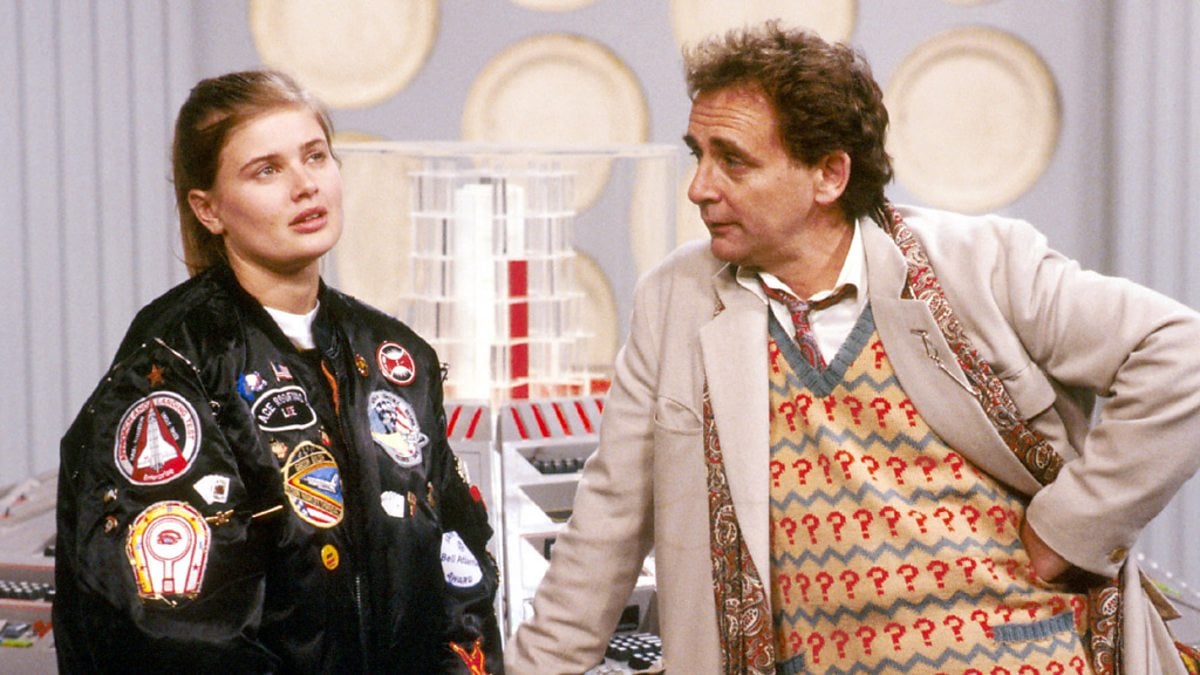
But Ace also taps into something deeper, which is part of ‘Dragonfire’s broader appeal. There is a ‘fairy tale’ quality to her character, having been based on Dorothy Gale from The Wizard of Oz. She isn’t just a rebellious teen, but a young girl who is whisked off in a storm to a distant, magical world. On her arrival, she finds herself on a quest for buried treasure, rumoured to be guarded by a fire-breathing dragon. Sound familiar?
Certainly, we see these tropes appear in many a fairy tale, and they are oft-used because they resonate. That is not to say that the writer Ian Briggs was derivative; he was candid in his use of The Wizard of Oz for inspiration (Ace’s real name is Dorothy, after all.) Briggs adopted a story structure that he knew worked, along with some of its tropes and conventions, and added his own voice to the recipe. Even William Shakespeare did that.
And there are plenty of original ideas in ‘Dragonfire.’ The mysterious world that Ace finds herself in is in fact Iceworld – a colony-cum-supermarket which (spoilers) turns out to be a gigantic spaceship. And it’s not just a spaceship; it’s the prison of a convicted criminal known as Kane who, after several thousand years’ worth of confinement, has risen to become king of his own little world and now lords it over the people of Iceworld. He is undoubtedly the coldest villain of Season 24, in every sense.
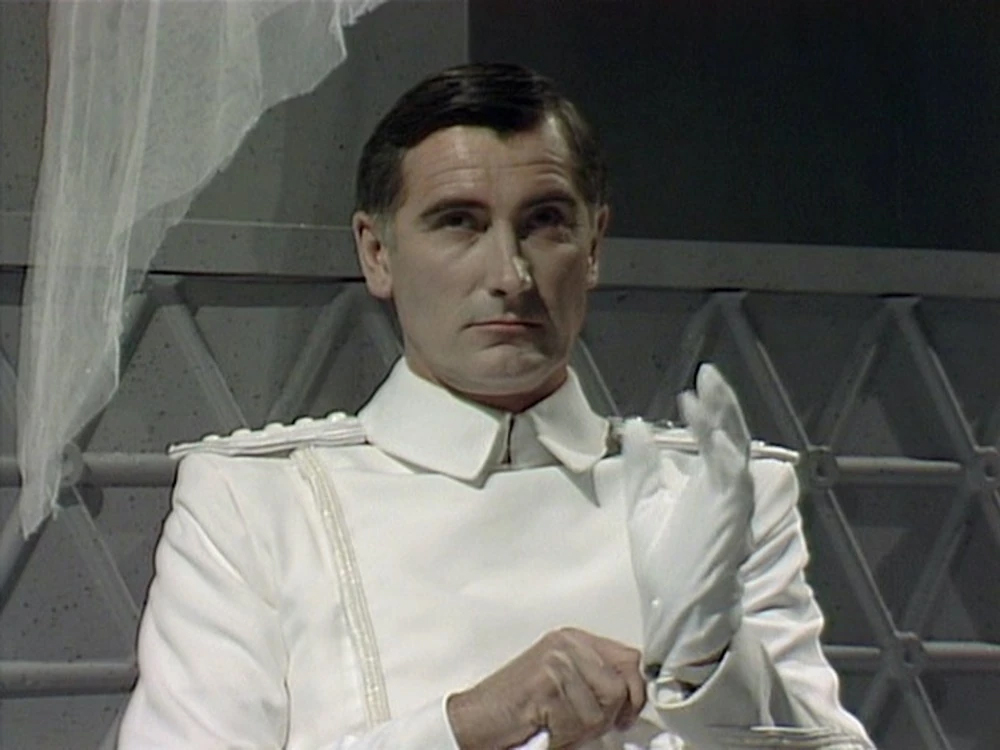
Does this mean that the actor Edward Peel gives a ‘pantomimic’ performance, in-keeping with the conventions of the fairy tale genre? Surprisingly not. Peel interprets Kane with great reality, and his performance is cool and sinister, even when the script might have tempted him to crack open the ham. This is astonishing, particularly when one remembers that he is essentially the psychotic and merciless manager of frozen food outlet, hell-bent on the acquisition of buried treasure for his own evil ends. “At last,” he hisses, “after three thousand years, the Dragonfire shall be mine!” All that’s missing is the maniacal laughter and peels of thunder, but Peel’s performance is so careful and considered that it feels real, and genuinely scary.
That’s not to say that ‘Dragonfire’ is without humour; there’s plenty of it, and much of it comes from guest actor Tony Selby making a return as Sabalom Glitz. He’s the quintessential ‘wheeler dealer,’ as we say in the UK – a bit of a ‘Del Boy in space.’ If ‘Dragonfire’ were set in Bendiorm, you’d find Glitz on a street corner trying to sell you a knock-off Rolex.






But in ‘Dragonfire,’ he’s simply after the buried treasure. Like The Wizard of Oz, every character in the story has a reason for going on the quest, and Glitz is solely interested in the riches that his prize promises. This gives his character hilarious tunnel vision; even when the Doctor is dangling over a precipice, pleading for his life, Glitz is so unmoved it’s almost comical.
In many ways, Glitz is a stereotype – a bit like the Sid James to McCoy’s Hancock, if anyone is old enough to get that reference. But he was one of the most popular characters of the previous season (the brainchild of Doctor Who master Robert Holmes) so it was a canny move on the part of the production team to bring him back for a second outing. He was beloved by the viewers, and he remains so, judging by how fondly ‘Dragonfire’ is remembered. He was even referenced by Mel in the modern era.
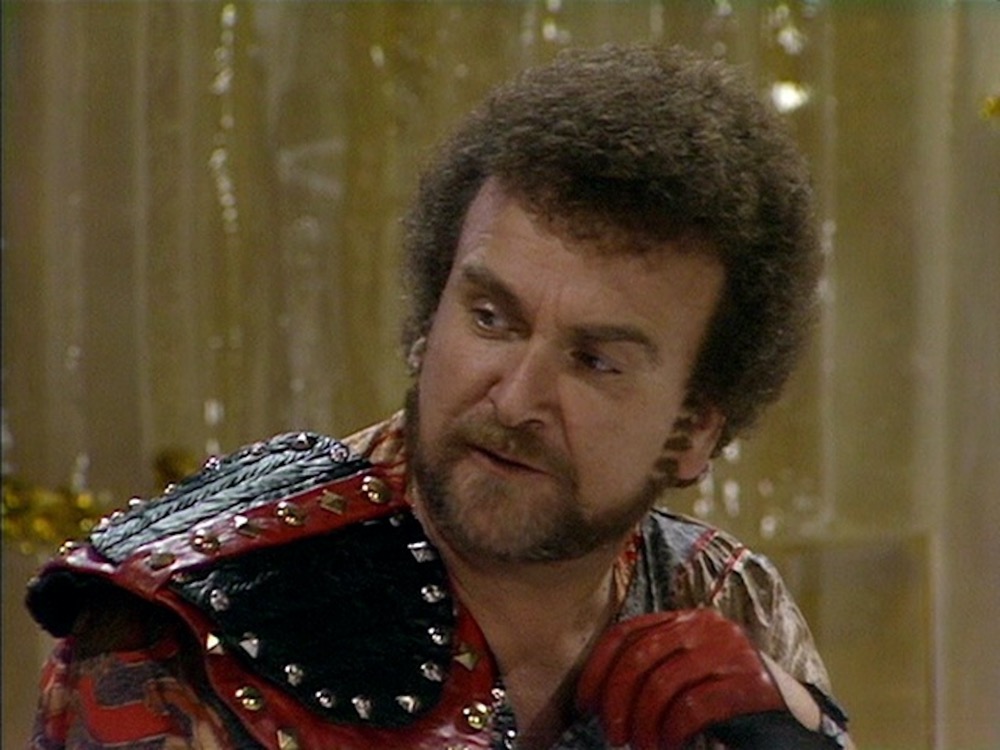
Simply put, Glitz is ‘Dragonfire’s comic relief – the perfect contrast to Edward Peel’s Kane. There is levity in other places, of course, but it’s… controversial, to say the least.
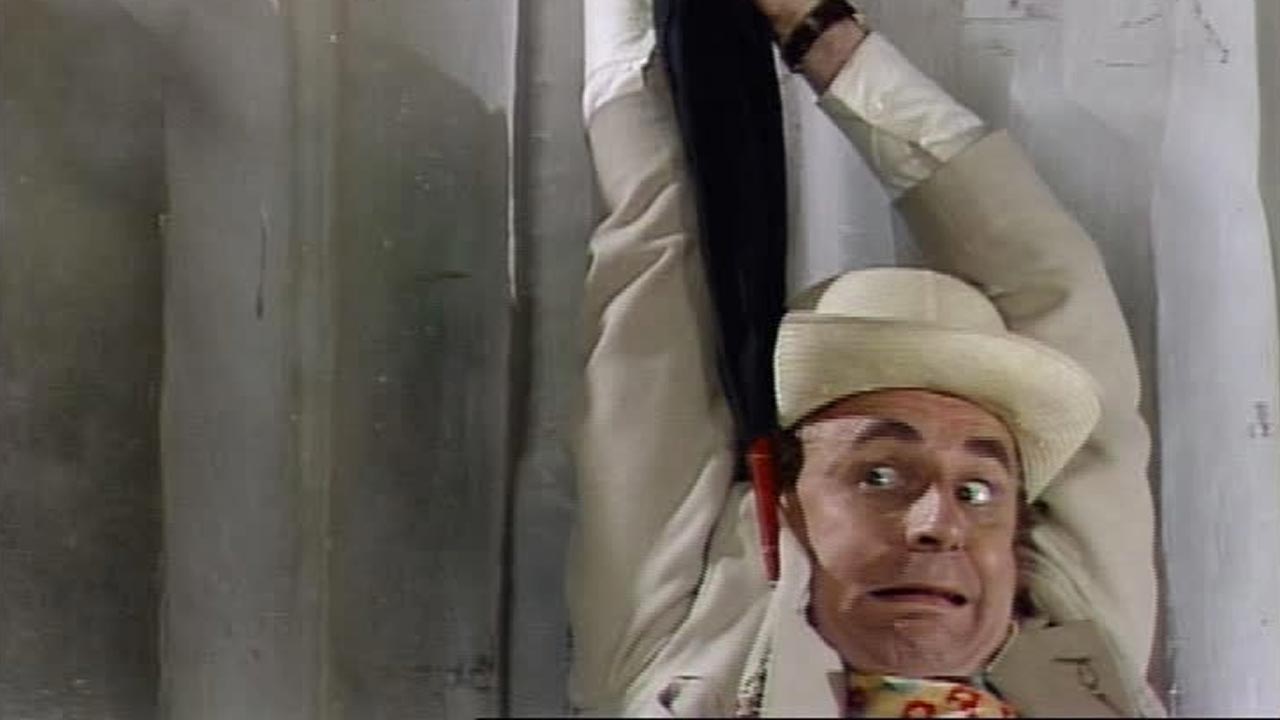
We refer, of course, to the infamous scene at the end of part one where the Doctor, for no apparent reason, uses his question mark umbrella to climb over a ledge, and proceeds to slide down. Suddenly, he’s in danger of plunging to his death. Cue the end credits; it’s a literal cliff-hanger, nudge nudge. See what they did?!
Alas, the joke was lost on many people, and even to this day fans are questioning what on earth the Doctor was thinking, or if indeed he was thinking at all. The only explanation that makes sense is that this was a fourth wall-breaking moment – a chance for the writers to shine a light on Doctor Who‘s episodic format and say, “Look, we’re 23 minutes in, we need a cliff-hanger – let’s engineer one! Isn’t it silly?”
And whilst few people got the joke, it didn’t do ‘Dragonfire’s reputation any harm. It even spawned a sequel, of sorts, with Briggs returning with Season 26’s ‘The Curse of Fenric,’ which tied up some of the plot points established by its predecessor. And ‘Dragonfire’ even let its presence be felt in the 50th anniversary year, with Clara Oswald visiting Iceworld to try and save the Doctor from tumbling into the abyss in ‘The Name of the Doctor.’
None of this is to say that ‘Dragonfire’ is without its flaws, but it’s clear why it resonated so deeply with fans in 1987, and why it continues to resonate to this day. It enjoys a worthy spot on our Blu-ray shelves.
So tell us, reader: What do you enjoy most about ‘Dragonfire’? And how do you feel about the Doctor’s decision to voluntarily throw himself off a cliff? Let us know in the comments below.

Leave a Reply