
Tinsel, Tekker and timey-wimey goodness… ‘Timelash’ is certainly a unique story in Doctor Who Season 22. But is it really as bad as its reputation suggests?
‘Timelash’ was always going to have a rough ride. It came after ‘The Two Doctors,’ which brought back Patrick Troughton, Frazer Hines, guest starred Jacqueline Pearce (of Blake’s 7 fame), enjoyed lush location filming on the streets of Seville, and was penned by one of the greatest Doctor Who writers of all time, Robert Holmes. And it was followed by what is widely considered one of the Sixth Doctor’s greatest adventures, ‘Revelation of the Daleks‘ (see if you can guess the returning villain.) Certainly, the odds were stacked against ‘Timelash’ from the off.
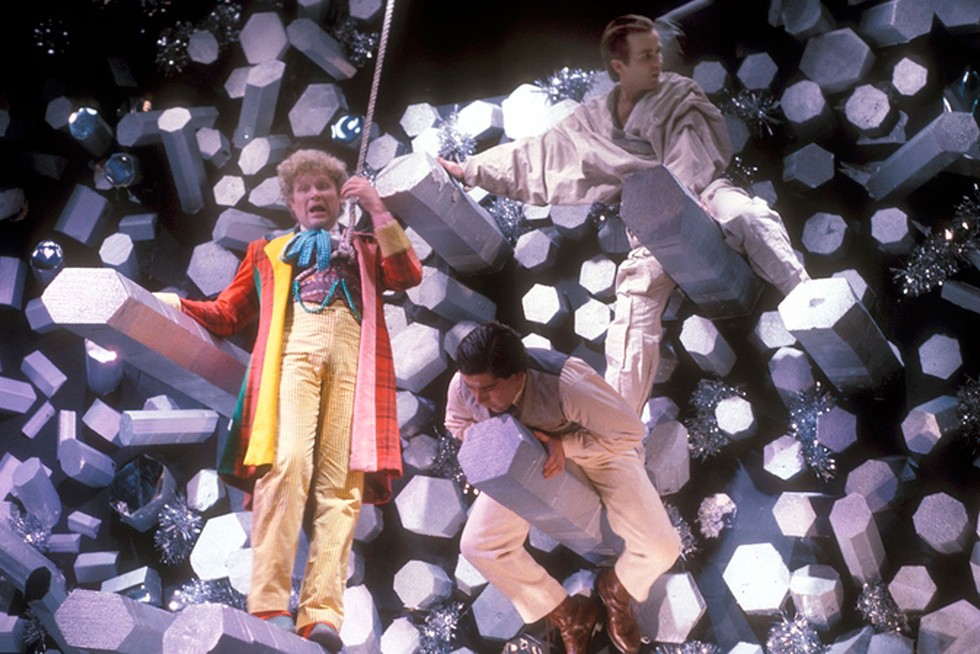
Does this mean that it is above criticism? Certainly not – especially when the production team used tinsel to realise the entrance to the eponymous time tunnel. Now, tinsel will always look like tinsel, however creatively it’s used. Critics are well within their right to point – with raised eyebrows – at some of the questionable design choices.
At the same time, one could also argue that the festive set dressing is one of the highlights of ‘Timelash.’ Surely this ‘cheapness’ is all part of the charm? Sure, the viewer must suspend their disbelief, but that’s true of many a Doctor Who story. After all, nobody ever went to a panto (or indeed any theatrical production) for staunch realism. If the viewer approaches ‘Timelash’ in full knowledge of the fact that this is an ‘economical’ piece of creative expression, backed by a company that’s giving its all, does it matter if the audience can ‘see the strings’?
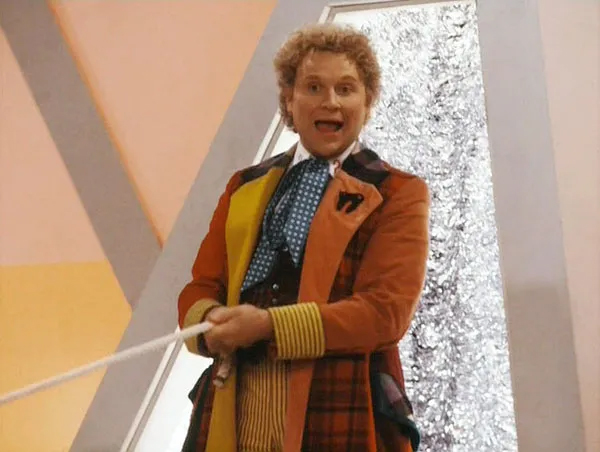
Because, in reality, the eponymous Timelash device wasn’t realised with tinsel because the production team didn’t care. Far from it. ‘Timelash’ simply didn’t have the money, as resources had been allocated elsewhere. Certainly, the producer John Nathan-Turner could have made ‘Timelash’ a more expensive production and cancelled the Spanish location filming for ‘The Two Doctors,’ but that would have been a tremendous shame. This story is simply an example of the production team doing the best they could with limited resources.
Indeed, if you look at the heart and soul that is being poured into the story by the Sixth Doctor Colin Baker, and Nicola Bryant as Peri, and Paul Darrow as Tekker, and David Chandler as Herbert, it’s clear that all involved wanted to make something entertaining and fun.
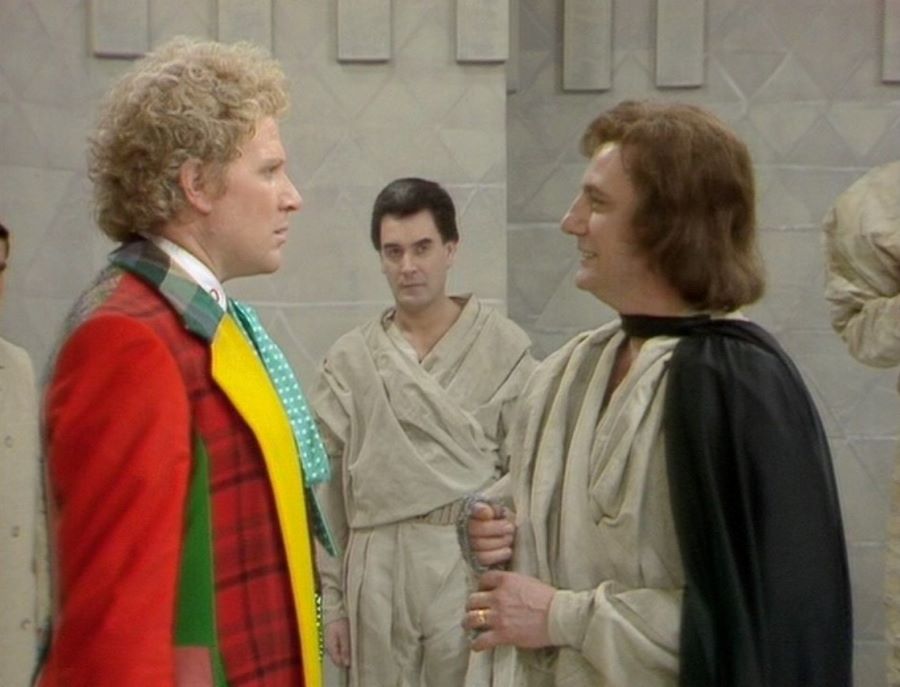
Now, Paul Darrow’s interpretation of the villainous Tekker might not be to everyone’s taste, but it’s certainly not dull. Darrow, controversially, decided to base his performance on Laurence Olivier’s Richard III, and as such it is rather OTT – in fact, there is little scenery left to be eaten once Darrow has done dining. Arguably, a version of ‘Timelash’ without Darrow’s Tekker would be a bit like a fruit scone without the jam – palatable, but rather dry and crumbly. After all, it takes a certain skill to utter the words, “Goodbye Doctor – unpleasant journey!” Darrow, in short, makes the story irresistible.
Now, criticisms have been levelled at the script over the years, and there is some validity to these points. ‘Timelash’ is not a masterful piece of storytelling, and nor is it a contender for the greatest Doctor Who story ever written, but it’s worth remembering that this was one of the writer Glen McCoy’s first television gigs, having only penned two episodes of Angels prior. He can be forgiven for failing to deliver a stone-cold classic on his first attempt.
But ‘Timelash’ is still rich in ideas. McCoy’s pitch was essentially, ‘where did H.G. Wells get his ideas from?’ and ‘what if H.G. Wells travelled with the Doctor?’ These are fascinating questions, and perfect for Doctor Who. In ‘Timelash’ there are many overt nods to Wells’ work, such as The Time Machine (specifically the Morlocks creatures) and The Invisible Man.
Plus, the actor David Chandler injects the character with an infectious charm and a childlike naivete which is captivating to see as he basks in all the wondrous new ideas that are flashing before his eyes – a concept that the revived series would continue with Charles Dickens and ‘the blue elementals.’





Inevitably, Chandler’s interpretation leads to some great moments of humour in ‘Timelash,’ particularly the scene where Herbert first encounters the Doctor and tries to ‘exorcise’ him, before attacking him with a Bible. Colin Baker actually selected this moment as one of the highlights of his tenure for The Colin Baker Years tape.
At the same time, there’s no denying that McCoy’s inexperience as a writer did lead to problems in post-production. Episode two reportedly underran by five minutes, and the script editor Eric Saward had to conjure up some simple TARDIS scenes that had to be mounted during the production of ‘Revelation of the Daleks.’ They’re obviously padding, and Nicola Bryant claims that these scenes represent some of her worst work as an actor. But it does lead to a touching and amusing bit of interplay between Herbert and the Doctor, when Herbert stows aboard the TARDIS and vows to stand “shoulder to shoulder” with the Time Lord as they face impending death.
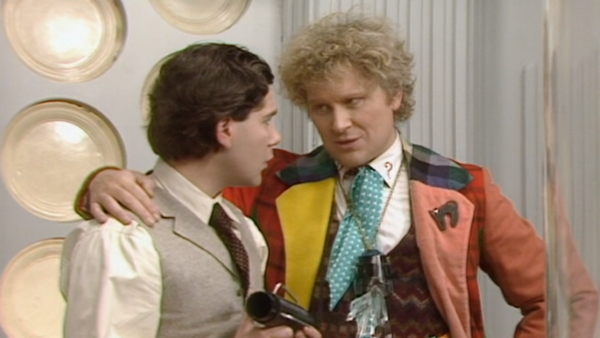
And whilst it’s true that the original version of ‘Timelash‘ wasn’t laced with sparkling dialogue, the cast were given free rein to adlib. One of the best examples is the Sixth Doctor’s admonishment of Tekker when he blusters, “You gave me your word, you micro-cephalic apostate!” And then there is the Borad’s remark: “Another expedition into the realms of duplicity…” This was, allegedly, a re-write of the much simpler line, “You’re lying.” And so, ironically, ‘Timelash’ actually includes some of the greatest dialogue of the Sixth Doctor’s era.
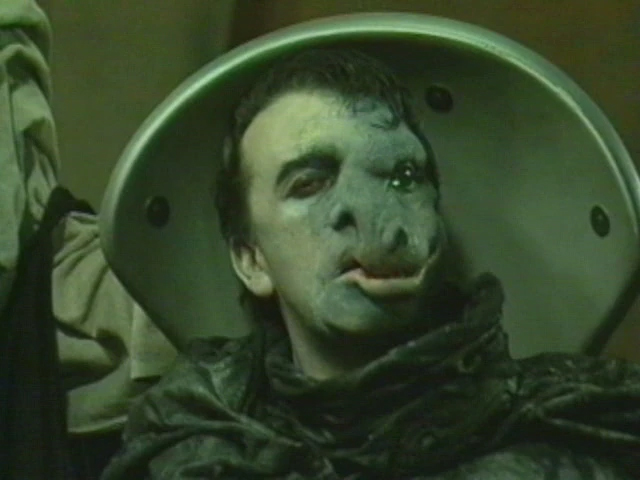
And on the subject of the Borad, a special mention must go to Robert Ashby, whose interpretation of the story’s main villain is more chilling than the cold side of the pillow. It’s careful, considered and understated – the perfect contrast to Darrow’s Tekker, realised with an exceptional piece of makeup which, again, must stand out as one of the greats of Season 22. The director Pennant Roberts chose not to reveal the Borad’s true appearance until episode two, ramping up the tension and ensuring a more powerful punch when his face was finally seen.
So is ‘Timelash’ an overlooked masterpiece? Certainly not, and it has its fair share of problems, but there is so much to love, and it deserves to be watched in the spirit in which it was made. As Nicola Bryant pointed out in the making-of documentary, it’s still another Doctor Who story, and Doctor Who is always worth tuning into.
So how do you feel about ‘Timelash’? Is it as bad as its reputation suggests? And what are your favourite moments? Let us know in the comments below.
Leave a Reply