
Christopher H Bidmead – one of Doctor Who‘s most innovative and beloved script editors – has left us at the age of 84.
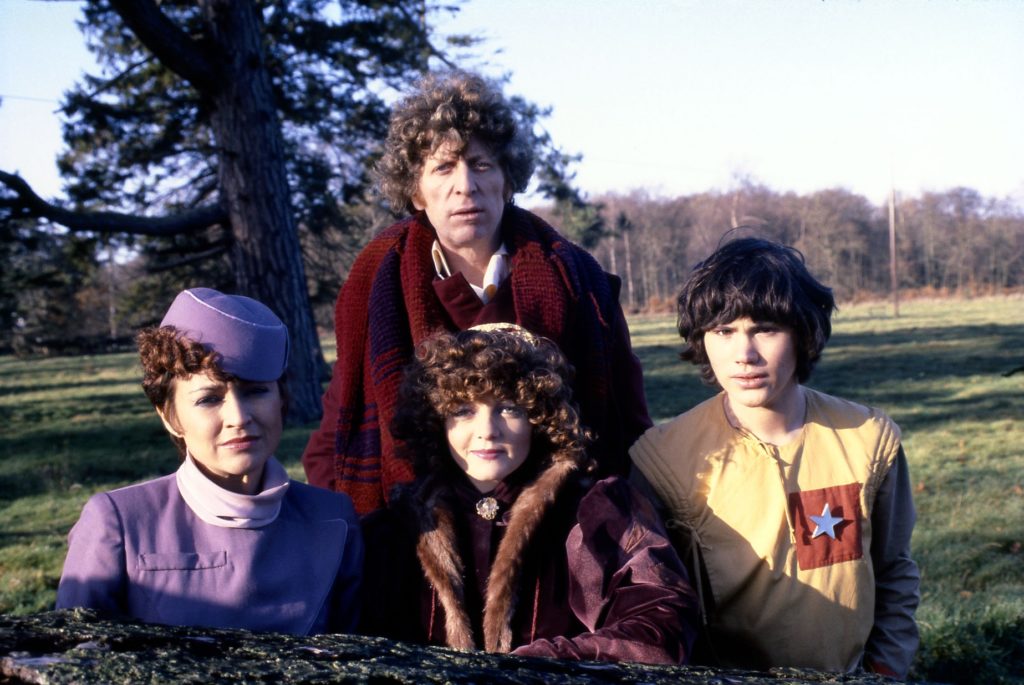
Christopher H Bidmead served as Doctor Who‘s script editor between 1980 and 1982, and was one of the show’s few writers to come from a scientific background. Indeed, this is partly why he was hired by the producer John Nathan Turner; he wanted to produce more ‘serious’ stories, which were grounded in real science and new and emerging scientific ideas.
And if you’ve ever watched a Doctor Who story that was penned or edited by Christopher H Bidmead, then you will see his scientific fingerprints all over it. Take, for example, his very first adventure as script editor ‘The Leisure Hive,’ which kicked off Tom Baker’s final season. Written by David Fisher, this offbeat story delved into the world of tachyonics, which was an emerging scientific idea at the time (tachyons are theoretical particles which travel faster than light.) And in the story, the Time Lord and Romana find themselves in a recreational facility which has managed to harness these particles for the purposes of duplicating and manipulating organic matter.
Christopher H Bidmead’s skill was in recognising the potential of such ideas, and finding imaginative ways to build Doctor Who stories upon them. Did the science always make sense? No. Were viewers confused? Sometimes. But there was no faulting the programme’s ambition and zaniness, and one thing that Christopher H Bidmead was skilled at was encouraging his viewers to think, and to take the show seriously. Prior to this, Doctor Who had endured many years of ‘goofery’ which sometimes made it seem more like a comedy than a science fiction drama (see ‘The Horns of Nimon’ for more details.)
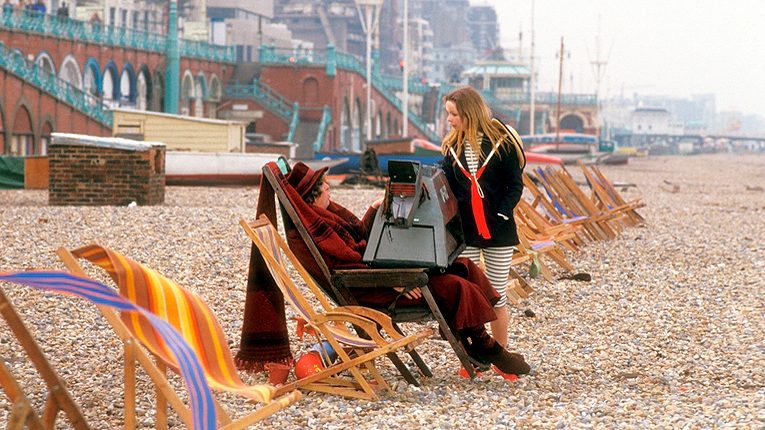
And one concept that Christopher H Bidmead was particularly interested in was the TARDIS, as he himself stated on the BBC DVD range. This was a machine that was bigger on the inside than the outside, and could travel to any planet in the universe, and to any date in that planet’s existence. It was a wild scientific idea, and yet it was one that (for the most part) had been largely unexplored in the annals of Whodom, unless you count the Sontarans‘ ‘fix’ with the sun lounger in ‘The Invasion of Time.’
As such, you will notice that Christopher H Bidmead pays particular attention to the TARDIS in his adventures, and the machine features prominently in ‘Logopolis,’ ‘Castrovalva’ and ‘Frontios.’ ‘Frontios’ is an interesting one though, because (spoilers) the TARDIS is seemingly destroyed in this story, until the Doctor finds its ‘bleeding dimensions’ buried underground.
And in ‘Logopolis,’ the Doctor finds himself having to deal with a TARDIS within a TARDIS – a trap laid-out by his arch enemy the Master. It’s a bit like a Russian doll, with a TARDIS appearing inside another TARDIS, which also contains a TARDIS, which also contains a TARDIS, and so on. And the dimensions become increasingly unstable the further the Doctor travels. It’s a lot to take in but, again, this was Bidmead’s aim; he was trying to produce a thought-provoking programme, and not another piece of proverbial ‘moving wallpaper.’
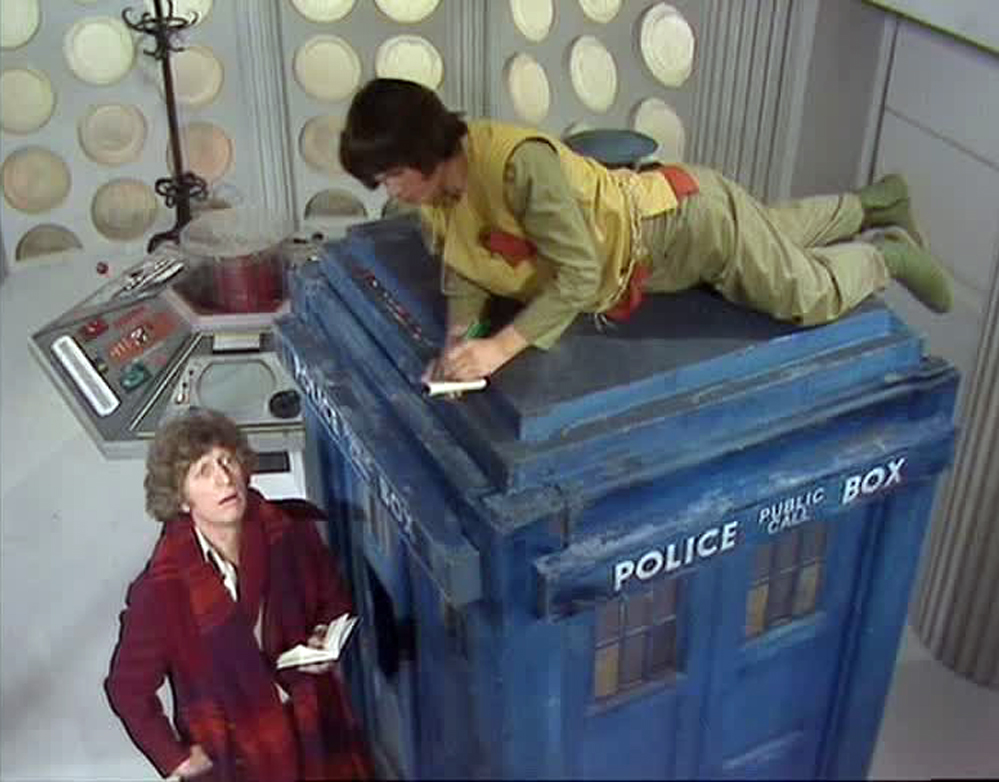
Christopher H Bidmead also introduced viewers to such complex scientific ideas as entropy, which was a key plot detail in ‘Logopolis.’ Entropy, for those of who don’t know, is the term used to describe the state of an object – i.e. how ‘ordered’ or ‘disordered’ it is. Simply put, an object with high entropy can have its particles rearranged in lots of different ways and still maintain its ‘shape.’ A low entropy object, on the other hand, is restricted in the number of ways it can be rearranged, and is liable to collapse if its particles are messed with. (This is very much an idiot’s definition, by the way, as I’m not a scientist!)
And in ‘Logopolis,’ the Doctor encounters a group of mathematicians whose calculations are slowing down the amount of entropy (disorder) in the universe – that is, until the Master meddles with their operation and the universe starts to collapse.






And if you’re already feeling confused, hold on to your scarf – Christopher H Bidmead wrote a sequel to ‘Logopolis’ called ‘Castrovalva’ which was equally head-scratching. By this point, the Doctor has managed to halt the entropy wave, but he finds himself in a bizarre domain generated by the power of his companion Adric‘s mind, inspired by some of Escher’s trippiest paintings. You’ve probably seen the artist’s most famous one – the building which is made out of nonsensical staircases that lead to nowhere, and fall in on themselves. This building forms the backdrop of ‘Castrovalva,’ and it’s just as confusing as it sounds.
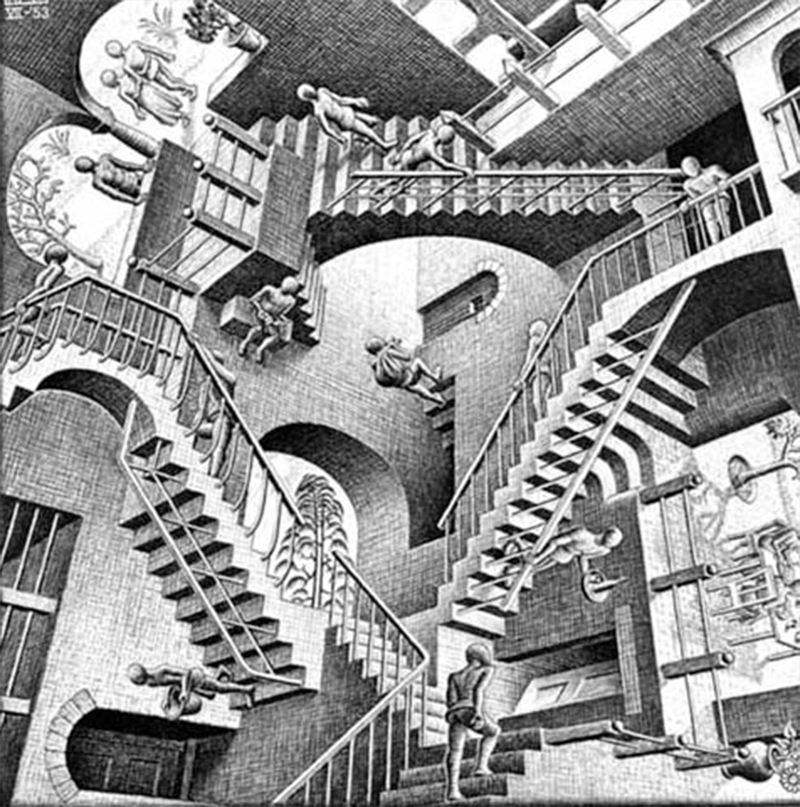
But that’s the point. The Master is trying to confuse the vulnerable and newly-regenerated Doctor, so there is no expectation for the viewer to have a clear grasp of what’s going on. Again, Christopher H Bidmead was being clever, and forcing his viewers to sit up and pay attention. In some ways, he was like the Steven Moffat of his day, and it’s interesting to note that Moffat cited ‘Logopolis’ and ‘Castrovalva’ as two of his favourite stories when he posted about Bidmead’s death on X.
Another of Christopher H Bidmead’s qualities was his willingness to speak his mind, and not necessarily in a rude way. For instance, he took the job as Doctor Who‘s script editor despite telling John Nathan-Turner that he felt the show had become too silly. And he was vocal in his dislike of the Time Lord’s new question mark lapels at the start of Season 18, and the opening scene of ‘The Leisure Hive.’ In fact, if you listen to the story’s DVD commentary, Bidmead airs his criticisms to the director himself, Lovett Bickford, describing the scene as overly long and pointless, although Bickford politely defends it.
In short, Christopher H Bidmead knew his own mind when working on Doctor Who and was never afraid to share his opinions or defend his work. He oversaw one of the biggest changes in the series’ history when John Nathan-Turner came on board in 1980, and was instrumental in Tom Baker’s departure and regeneration. He took the show in a new direction and created stories which, while divisive at times, were bold and ambitious, and grounded in real science. The mark that he left on the world of Doctor Who is a significant one, and we are all the poorer for his passing.


I wish you made the shorter season 18 burgundy scarf.